Viterbi Path Structure
Class Diagram
The UML diagram of Fig. 2 shows the overview of the class.
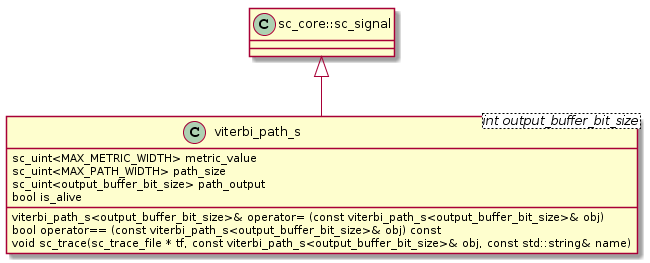
Fig. 2 Viterbi Path Structure
Class Description
-
template<int
output_buffer_bit_size>
classviterbi_path_s¶ Viterbi Path Structure
-
sc_uint<MAX_METRIC_WIDTH>
metric_value¶ Metric Value
-
sc_uint<MAX_PATH_WIDTH>
path_size¶ Current size of the path
-
sc_uint<output_buffer_bit_size>
path_output¶ Decoded value because of the taken path.
-
bool
is_alive¶ Flags the validity of the information stored in the structure.
-
inline viterbi_path_s<output_buffer_bit_size> &
operator=(const viterbi_path_s<output_buffer_bit_size> &obj)¶ Overload the = operator
Parameters: const viterbi_path_s<output_buffer_bit_size>& obj – Object to be assign to this instance.
-
inline bool
operator==(const viterbi_path_s<output_buffer_bit_size> &obj) const¶ Overload the == operation
Parameters: const viterbi_path_s<output_buffer_bit_size>& obj – Object to be equal to this instance.
-
inline friend void
sc_trace(sc_trace_file *tf, const viterbi_path_s<output_buffer_bit_size> &obj, const std::string &name)¶ Enables the tracing of the signal of type viterbi_path_s<output_buffer_bit_size>
Parameters: - sc_trace_file * tf – Trace file pointer
- const viterbi_path_s<output_buffer_bit_size>& obj – Object instance to trace.
- const string& name – Signal name
-
sc_uint<MAX_METRIC_WIDTH>
Structure
The structure of the clock divider is trivial since it has only one process.